
Financial Insights & Expert Advice
Explore articles, tips, and strategies to help you make confident money decisions at every stage of life.

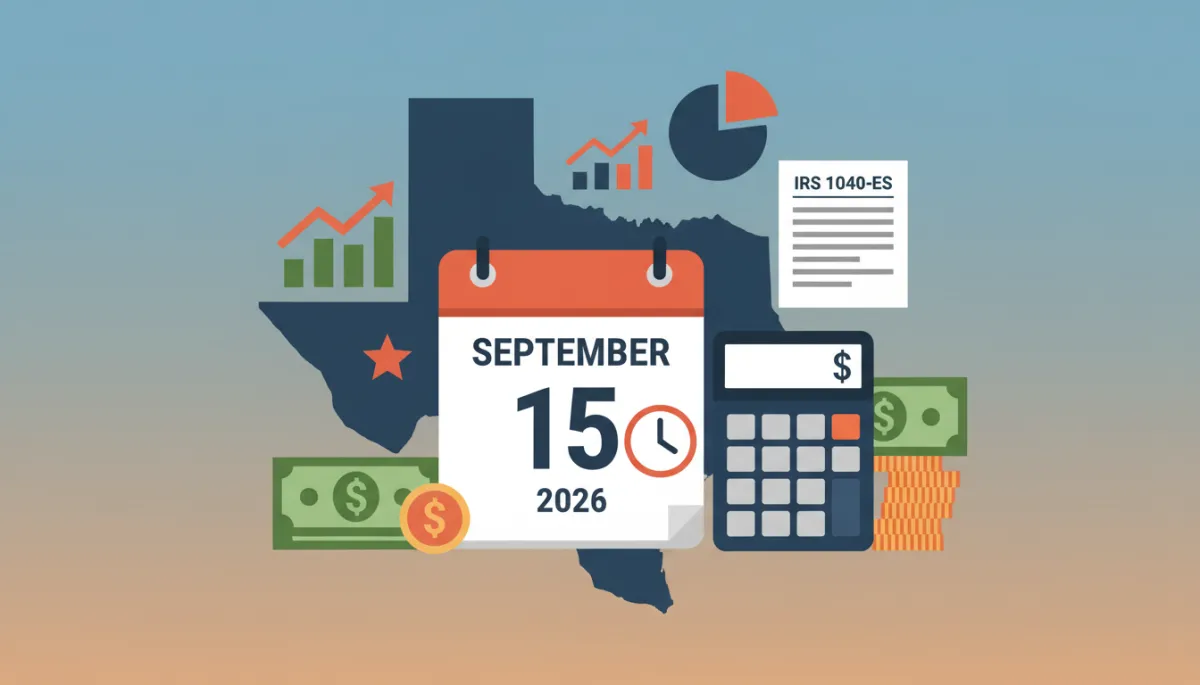
Quarterly Taxes for Texas Freelancers: Sept 15 Deadline
Tax & Financial Services, quarterly estimated taxes Texas, self-employed tax payments Fort Worth
Quarterly Estimated Taxes for Self-Employed Texans: What Fort Worth Freelancers Need to Know Before September 15
For self‑employed workers in Fort Worth, the next big federal tax date is almost here — the Q3 estimated tax deadline on September 15, 2026. If you freelance, consult, drive for apps, or run a small business without regular paycheck withholding, this date matters just as much as April 15. Missing it can mean penalties, surprise tax bills, and unnecessary stress when you finally file your 2026 return.

Why September 15 Matters for Fort Worth’s Self‑Employed Community
The IRS expects tax to be paid as you earn income throughout the year — not in one lump sum next April. Employees meet this requirement through paycheck withholding. Self‑employed Texans, however, usually meet it through IRS quarterly payments, also called estimated taxes, using Form 1040‑ES.
For 2026, the estimated tax due dates are April 15, June 15, September 15, and January 15, 2027. The September 15 payment covers income you earned roughly during June, July, and August. If your Fort Worth freelance or small‑business income has grown this summer, skipping this Q3 estimated taxes deadline can trigger underpayment penalties, even if you pay your full tax by the time you file your return in 2027.
Who in Fort Worth Must Pay Quarterly Estimated Taxes?
The IRS rules are the same in Texas as anywhere else — but they especially affect people whose income does not have tax withheld. You generally must make quarterly estimated payments if both of the following apply (see IRS Estimated Taxes guidance on irs.gov):
- You expect to owe at least $1,000 in federal tax for 2026 after subtracting withholding and refundable credits, and
- Your withholding and refundable credits will be less than the IRS safe harbor amount (explained below).
In Fort Worth, this commonly includes:
- Freelancers and independent contractors — writers, designers, IT consultants, rideshare and delivery drivers, real estate agents, and more.
- Sole proprietors and single‑member LLC owners reporting income on Schedule C.
- Partners in partnerships and some S‑corporation shareholders who receive pass‑through income without sufficient withholding.
- Anyone with significant investment, rental, or side‑gig income on top of a W‑2 job, when employer withholding is not enough.
How to Calculate Your Quarterly Estimated Tax Payment
The IRS provides Form 1040‑ES, which includes a worksheet to estimate your annual tax and divide it into quarterly payments. In practice, most Fort Worth freelancers and small‑business owners follow these steps:
- Estimate your total 2026 income. Add up expected income from self‑employment, side gigs, rental properties, interest, dividends, and any W‑2 wages. For many, this is based on year‑to‑date income plus a realistic projection for the rest of the year.
- Subtract deductions and adjustments. Include the standard or itemized deduction, retirement contributions, health insurance deductions for the self‑employed, and other adjustments allowed on Form 1040‑ES.
- Calculate your income tax and self‑employment tax. Use the current IRS tax brackets to compute income tax, then add self-employment tax Texas (Social Security and Medicare on your net self‑employment income). This is where many DIY filers underestimate what they owe.
- Subtract credits and any withholding. If you or a spouse still receive W‑2 wages with withholding, include those amounts, along with any credits you expect to claim (for example, child tax credit).
- Divide the remaining tax by four. The result is your annual tax shortfall — divide by four to find your typical quarterly payment. If your income is higher in some quarters than others, you can use the IRS annualized income method to match payments more closely to when you earn income.
Many Fort Worth business owners search for “1040-ES Fort Worth” or “freelancer taxes Texas” when they realize they need help with this calculation. Working through the 1040‑ES worksheet with a professional can prevent both underpayment penalties and overpaying the IRS all year long.
Understanding the IRS Safe Harbor Rules for 2026
The IRS “safe harbor” rules are designed to protect you from underpayment penalties if you pay at least a minimum amount during the year. For 2026, you generally avoid estimated tax penalties if your total payments (withholding plus estimates) are at least:
- 90% of your 2026 total tax, or
- 100% of your 2025 total tax (from your Form 1040), or
- 110% of your 2025 tax if your 2025 adjusted gross income was over $150,000 (or $75,000 if married filing separately).
In practice, many Fort Worth taxpayers choose the simpler prior‑year method: they take their 2025 total tax, multiply by 100% (or 110% for higher‑income households), and then divide by four for each quarterly payment. As long as those payments are made on time — including the Q3 estimated taxes payment due September 15 — they are typically shielded from underpayment penalties, even if 2026 ends up being a higher‑income year.
Real Penalties for Missing Quarterly Deadlines
The IRS does not usually send a notice on September 16 if you miss the Q3 deadline — but that does not mean there are no consequences. Underpayment penalties are calculated like interest and applied for each quarter you underpaid or paid late. The rate changes quarterly and is tied to federal interest rates, so in recent years it has been noticeably higher than in the past.
For Fort Worth freelancers and small‑business owners, this can mean:
- An additional penalty amount added to your tax bill when you file your 2026 return, even if you pay the balance in full at filing.
- Increased stress and cash‑flow pressure if you are already juggling business expenses, rent, and family obligations in Tarrant County’s growing economy.
While the penalty might look small on paper for one quarter, missing multiple deadlines or underpaying by a large amount can add up quickly. Planning ahead for the September 15 payment helps you avoid these avoidable costs and keeps your business finances cleaner when it is time to file.

Planning quarterly payments now helps Fort Worth businesses avoid costly underpayment penalties later.
How and When to Pay Your 2026 Quarterly Estimates
Once you know how much you owe for Q3, the next step is to send payment to the IRS on time. For self‑employed tax payments Fort Worth residents typically use one of these methods:
- IRS Direct Pay — pay directly from a checking or savings account at irs.gov without creating an account.
- EFTPS (Electronic Federal Tax Payment System) — a secure system that lets you schedule payments in advance, helpful if you want to set your September 15 payment now and not worry about it later.
- Check or money order with a 1040‑ES voucher — still allowed, though electronic payments provide faster confirmation and are easier to track.
Remember the remaining 2026 schedule: Q1 (April 15), Q2 (June 15), Q3 (September 15), and Q4 (January 15, 2027). Marking these dates on your calendar — and tying them to your business cash‑flow planning — is one of the simplest ways to keep your federal obligations on track.
Common Mistakes Fort Worth Self‑Employed Taxpayers Make
In working with local clients, several patterns appear again and again around self-employed tax payments Fort Worth residents struggle with:
- Ignoring self‑employment tax. Many new freelancers only budget for income tax and forget Social Security and Medicare, which can add roughly 15.3% on net earnings up to the wage base limit.
- Waiting until year‑end to “catch up.” Hoping to pay a large lump sum in December or at filing often leads to penalties and cash‑flow strain, especially when business slows unexpectedly.
- Mixing business and personal funds. Without a separate business account, it is easy to spend money that should have been set aside for quarterly estimated taxes Texas residents owe to the federal government.
- Not updating estimates mid‑year. When income increases — for example, after landing a new Fort Worth client or expanding services — quarterly payments should be revisited rather than waiting until the next filing season.
Texas‑Specific Considerations for Quarterly Estimated Taxes
Texas does not have a state income tax — which is good news for your personal return, but it can also create confusion. Some new Fort Worth entrepreneurs assume “no state income tax” means they are done with income tax entirely, overlooking significant federal obligations. In reality, your focus is entirely on federal income and self‑employment taxes, plus any local business requirements such as sales tax permits or franchise tax issues for certain entities.
Because there is no Texas withholding on wages for state income tax, many dual‑income households in Fort Worth rely solely on federal withholding from one spouse’s paycheck. If your freelance income has grown in 2026, that withholding may no longer be enough to meet the IRS safe harbor rules — making quarterly estimates essential to avoid penalties. Reviewing your situation before the September 15 Q3 deadline can help you reset your plan for the rest of the year.
If you operate through an LLC or S‑corporation, there may also be Texas franchise tax considerations separate from your personal estimated tax payments. Coordinating these pieces with a professional familiar with Fort Worth’s business landscape can keep you compliant on both the federal and state sides of your obligations.
As September 15 approaches, it is worth taking a focused hour to review your income so far, your previous year’s tax return, and your projected 2026 results. If the numbers are unclear — or if your business has changed significantly — a brief strategy session with a local professional can prevent missteps that linger for years. At IKAR Tax and Investments in Fort Worth, the team regularly helps freelancers, independent contractors, and family‑owned businesses align their quarterly payments with the IRS safe harbor rules while planning for long‑term goals. You can meet with them at 4200 South Fwy., Suite 2520, Fort Worth, TX 76115, or explore client reviews and directions through IKAR Tax on Google Maps before scheduling a visit or calling (817) 305-3433 to discuss your Q3 estimated taxes and broader financial picture.


Why Ikar Tax And Investments?
Frequently Asked Questions
Understand your options. Navigate your future with clarity.
What types of clients do you work with?
We work with individuals, families, and small business owners who want to take control of their finances and plan for the future. Whether you’re just starting out, preparing for retirement, or managing complex investments, our advisors can help.
How do I get started?
Simply schedule a free consultation through our contact page or give us a call. We’ll discuss your goals, review your current situation, and outline a personalized strategy to help you move forward.

Get Started
Ready to Simplify Your Taxes or Immigration Process?
Let’s create a personalized plan to handle your paperwork, forms, and filings.

COMPANY
LEGAL
SOCIALS
Copyright 2026. IKAR TAX AND INVESTMENTS INC. All Rights Reserved.